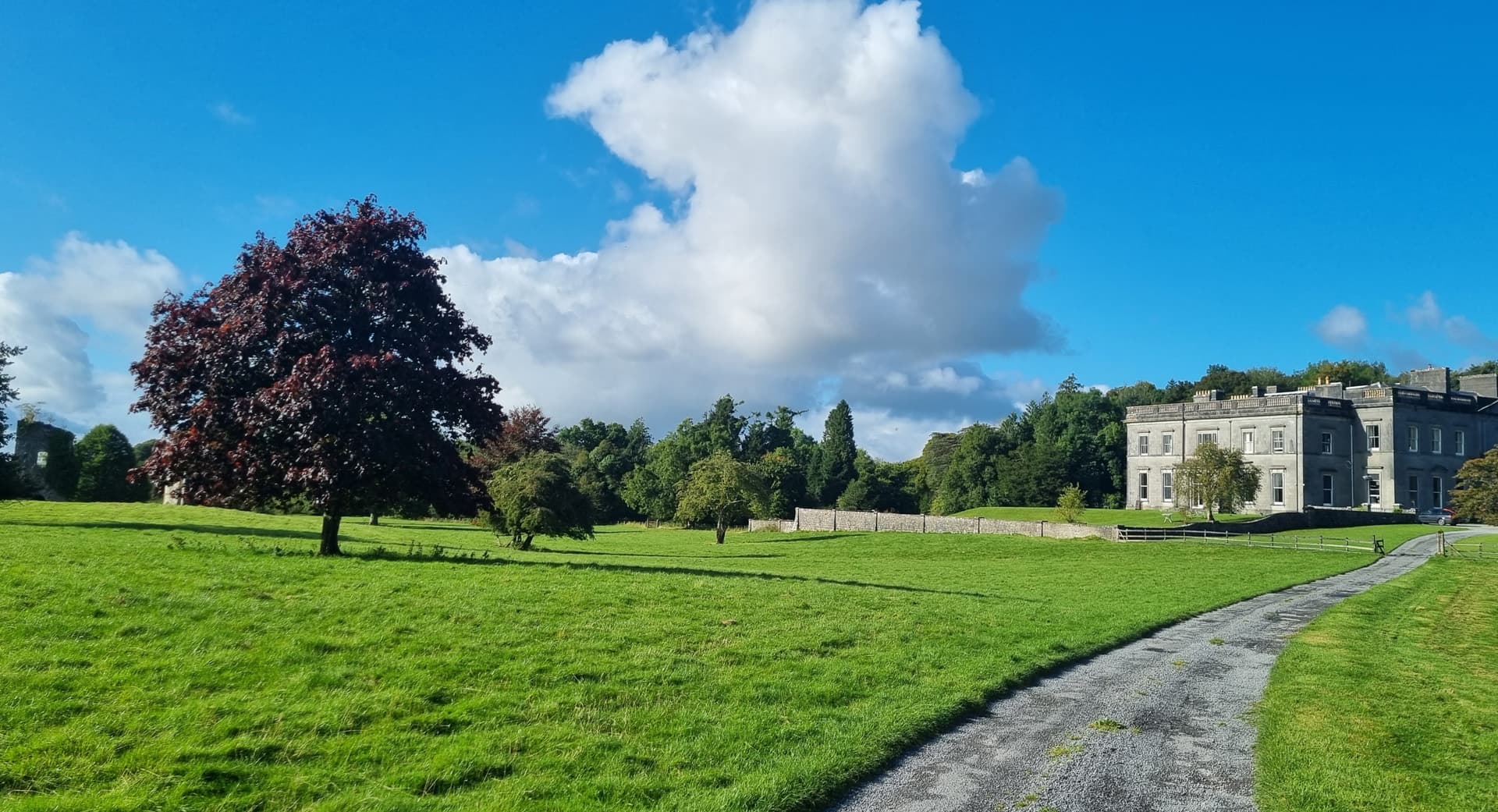
Aerial view of the Temple House estate in County Sligo — 1,000 private acres of parkland and lake

County Sligo · Est. 1665

Things to do

Nestled in the heart of County Sligo, Temple House offers more than just a luxurious stay — it provides a gateway to a wealth of memorable experiences.

The estate & beyond

Something for fun everyone

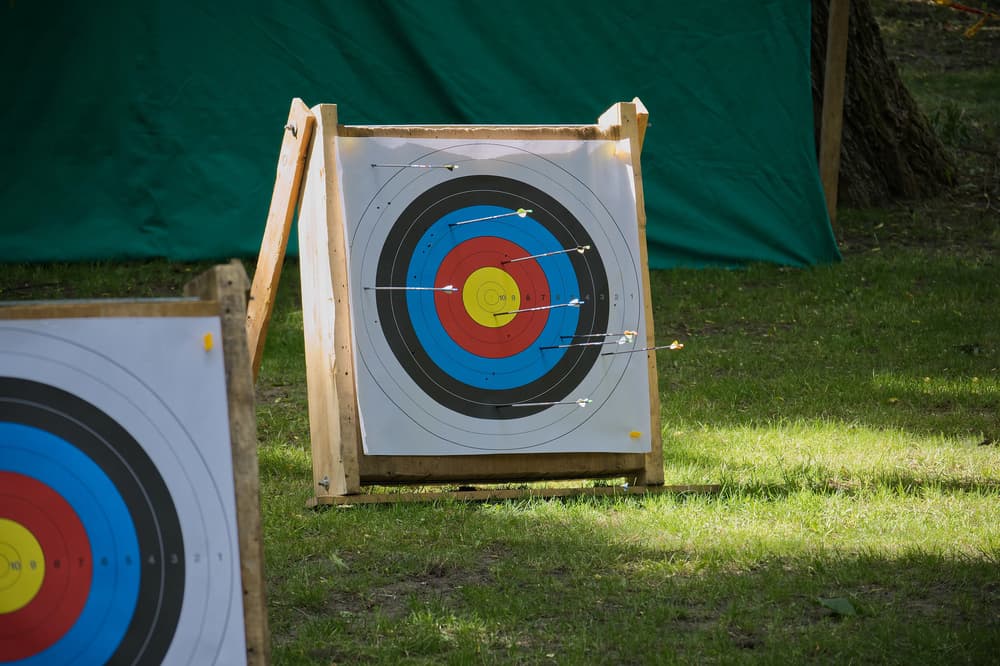
Whether you’re an adventure seeker, history enthusiast, or someone looking to unwind, our curated selection of activities ensures there’s something for everyone — from soft archery and boating on our own lake to championship links golf, seaweed baths and some of the most spectacular megalithic sites in Ireland.

Guest receiving a massage treatment at Temple House

Mobile Massage

Relax, even more — right here

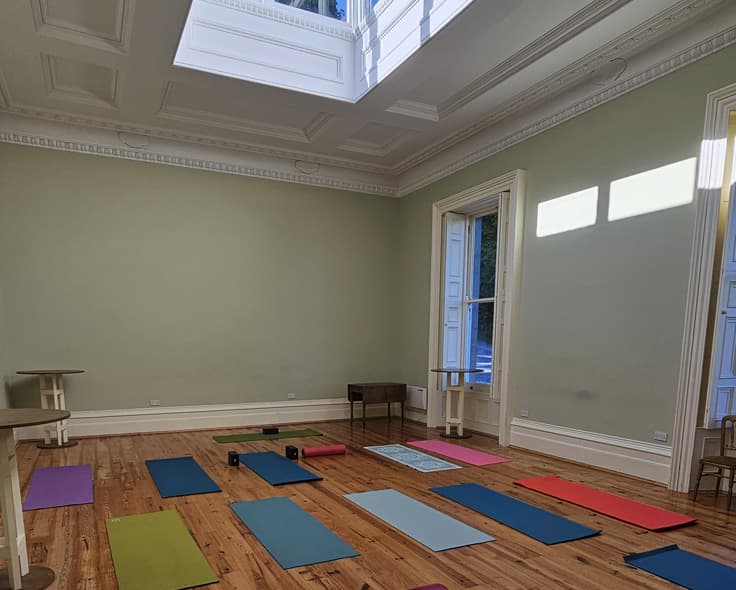
Combine a massage as part of the experience. Laura Barguena brings everything to you: sports massage, deep tissue, relief, relaxation, cupping, pregnancy, trigger point and trauma-informed treatments.

Shorter treatments possible for larger groups — just ask when planning your stay.

Out and about

Sligo and the west, from your base

Walkers at Carrowkeel megalithic site in County Sligo — hill walks near Temple House

Hikes and Walks

Plenty of space to explore across the estate, with maps provided — and so far, we’ve never lost anyone. Beyond it, the 49-mile Sligo Way.

Explore →

Dolmen at Carrowmore megalithic cemetery near Sligo — among the oldest monuments in Ireland

Heritage

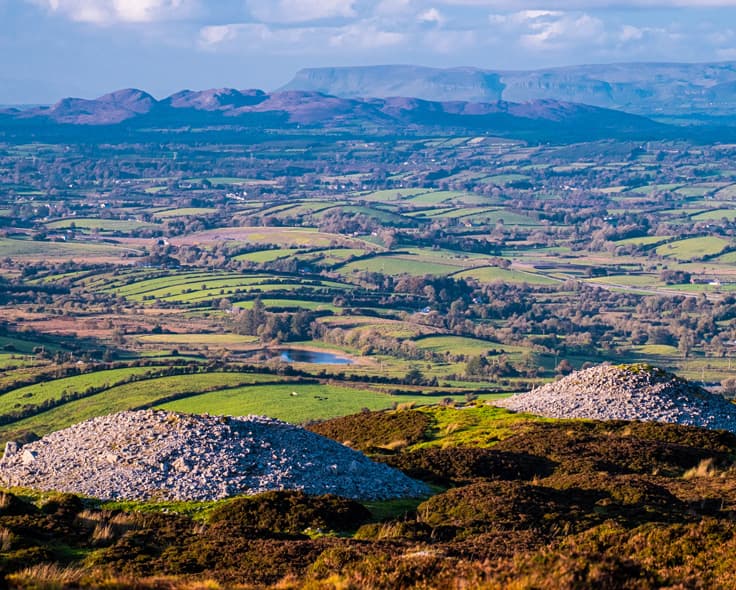
Carrowkeel, Carrowmore and Queen Maeve’s Cairn — some of the most spectacular archaeological sites in Ireland, all within reach of the house.

Explore →

Strandhill Golf Course links fairways in County Sligo — 30 minutes from Temple House

Golf

Three championship links courses in Co Sligo — Strandhill, Rosses Point and Enniscrone — with Temple House as your base.

Explore →

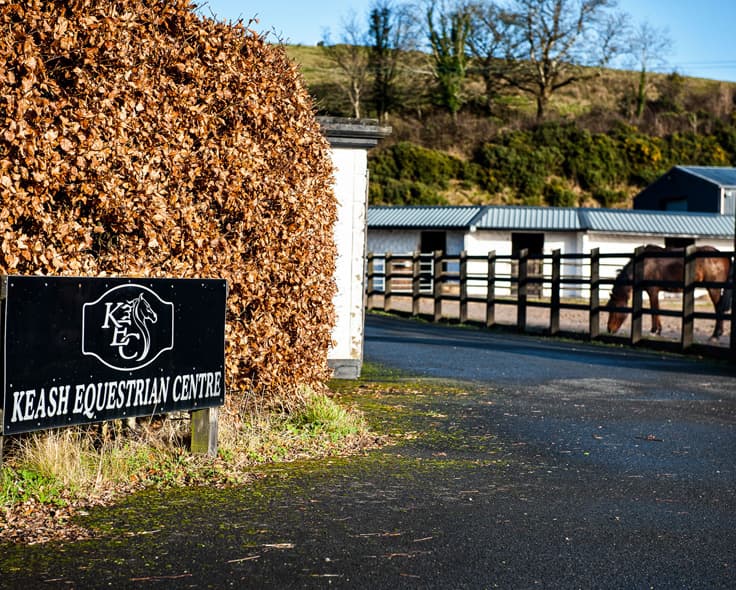
Horse riding at Keash Equestrian Centre near Ballymote, County Sligo

Horse Riding

Exhilarating canters by the sea with Island View Riding Stables, lessons at Keash Equestrian, and ride-outs in the Ox Mountains.

Explore →

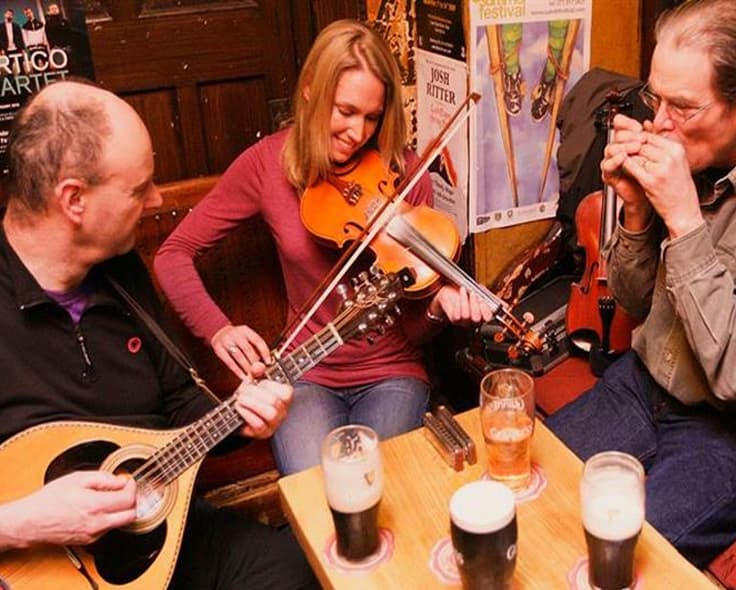
Traditional Irish music session in a South Sligo pub near Temple House

Traditional Music

Lively pubs within 25 minutes of Temple House — just 5 minutes away on Wednesdays and Fridays. Most sessions start around 10 pm.

Explore →

VOYA seaweed bath in Strandhill, County Sligo — 28 minutes from Temple House

26 km · 28 minutes

Seaweed Baths

A big bath of hot seawater and wild seaweed at VOYA in Strandhill — detoxifying and wonderfully soothing.

Explore →

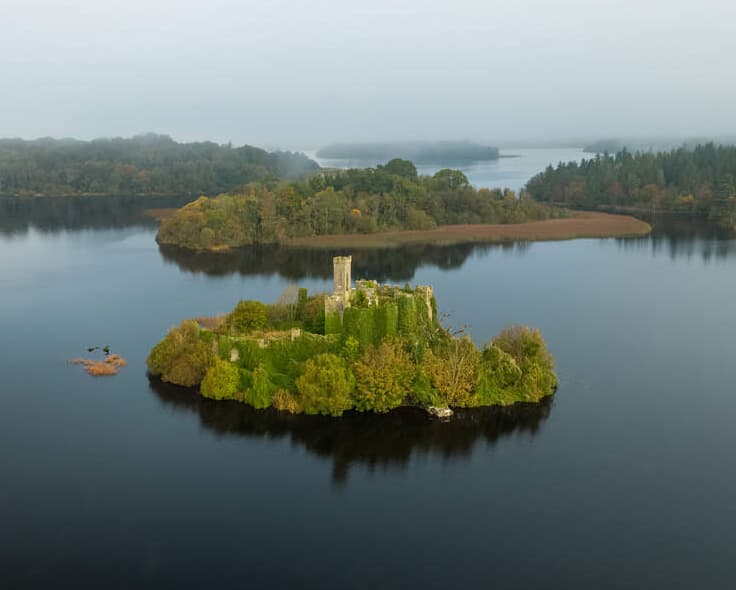
Castle Island at Lough Key Forest Park, County Roscommon — 36 minutes from Temple House

44 km · 36 minutes

Lough Key Forest Park

Boda Borg, Ireland’s only Tree Canopy Walk and Zipit Forest Adventures — a fantastic day out for all ages, rain or shine.

Explore →

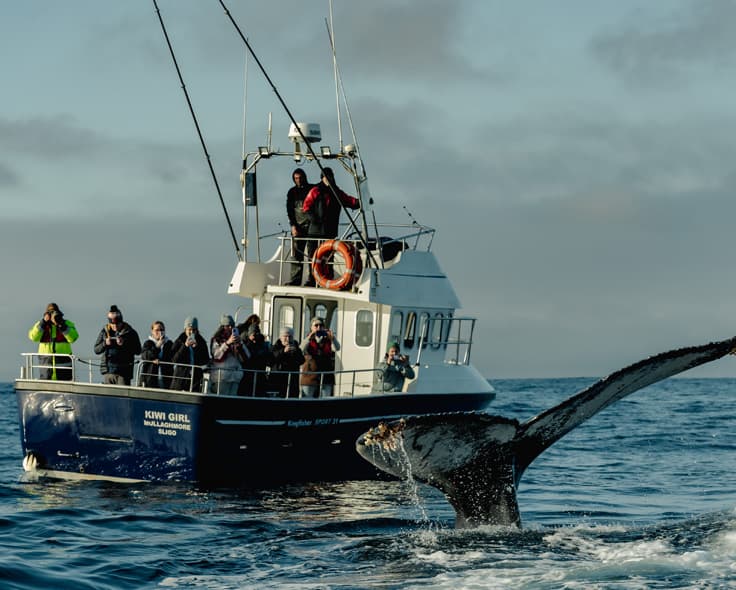
Kiwi Girl wildlife boat tour off Mullaghmore, County Sligo — whale and dolphin watching

30 km · 45 minutes

Wildlife Boat Tours & Deep Sea Fishing

Dolphins, seals, seabirds and — with a bit of luck — whales, with experienced skipper Declan Kilgannon from Mullaghmore Harbour.

Explore →

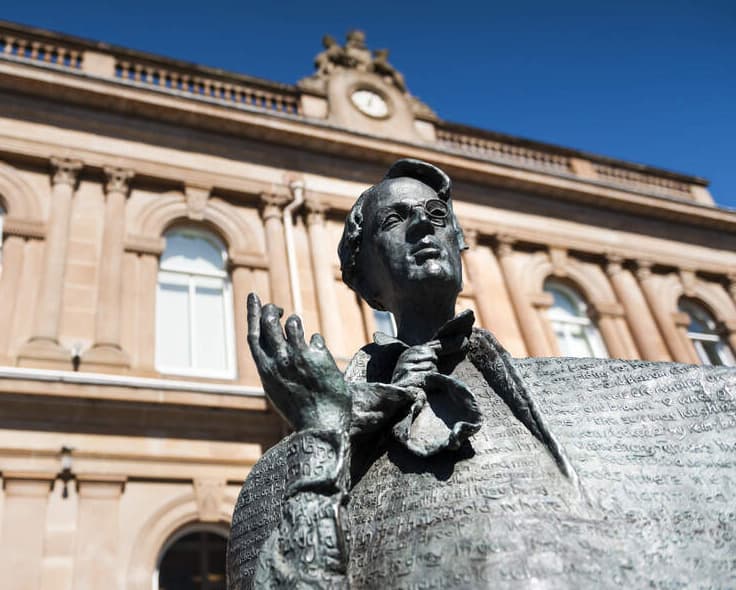
Statue of W.B. Yeats in Sligo town — the poet drew inspiration from County Sligo all his life

W.B. Yeats

The Land of Heart’s Desire — the poet’s grave at Drumcliffe, Lissadell House, and the Sligo landscape that inspired him all his life.

Explore →

The Wild Atlantic Way coastline at Easkey, County Sligo

The Wild Atlantic Way

Ireland’s stunning west-coast route, from Cork to largely undiscovered County Sligo — make Temple House your luxury base.

Explore →

Ancient Sligo

Heritage

County Sligo holds one of the richest prehistoric landscapes in Europe — passage tombs, court tombs, hillforts and castles, most within an easy drive of the house. Auriel Robinson, Wild Atlantic Way Ambassador and head guide of Seatrails, specialises in archaeological walks and Irish heritage trails.

Carrowkeel

Carrowkeel Neolithic passage tomb in the Bricklieve Mountains, County Sligo

Carrowkeel is a Neolithic hilltop passage tomb complex located on the northern plateaus of the Bricklieve Mountains. It contains 14 passage cairns identified and is one of a series of limestone plateaus aligned towards Knocknarea. Carrowkeel is one of the most spectacular and breath taking archaeological sites in Ireland.

Carrowmore

Carrowmore megalithic cemetery near Sligo — the largest in western Europe

Carrowmore is home to the largest and oldest collection of stone circles and dolmens known from Neolithic Ireland. These monuments are also among the country’s oldest, with the oldest pre-dating Newgrange by 700 years. Archaeologists have recorded over 60 tombs of which 30 are visible.

Carrowmore is one of the largest megalithic cemeteries in W. Europe and the guides and diagrams there can explain the significance of the Dolmens, Passage graves and stone circles around the visitor centre. Radiocarbon dating suggests 3,800 and 4,600 BC for two of the tombs. See: www.heritageireland.ie

Creevykeel Court Tomb

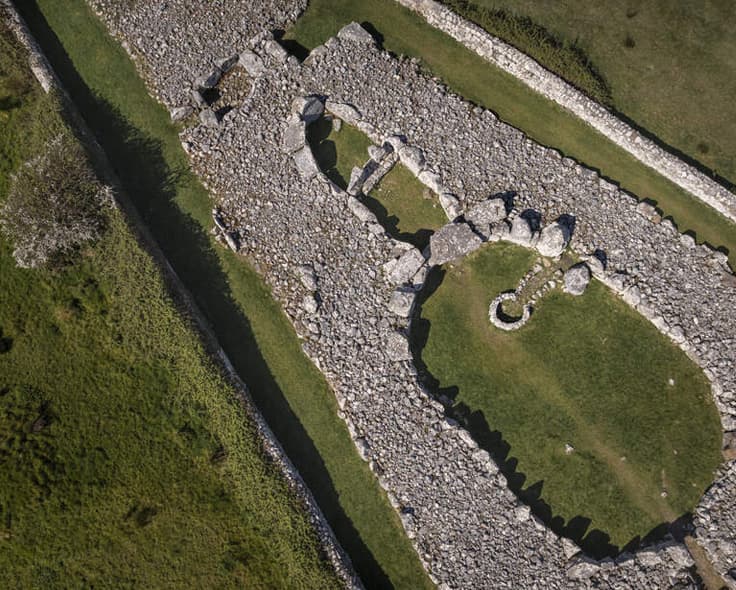
Creevykeel court tomb near Mullaghmore, County Sligo — one of the finest in Ireland

This monument is situated at the foothills of Tievebaun Mountain, near the sea at Mullaghmore, and is one of the finest examples in Ireland of what is known as a full-court tomb. Dating from the Neolithic period (c. 4000 – 2500 BC) it consists of a wedge-shaped cairn about 50m long, incorporating at its eastern end an oval-shaped court.

The entrance into the court is at the east, and consists of a narrow passage-way lined with upright stones. The court is among the largest of its type in Ireland, measuring 15m long by 9m wide. From the court is the entrance to the burial gallery which is divided by upright stones into two chambers and was originally covered by a corbelled roof.

Queen Maeve’s Cairn

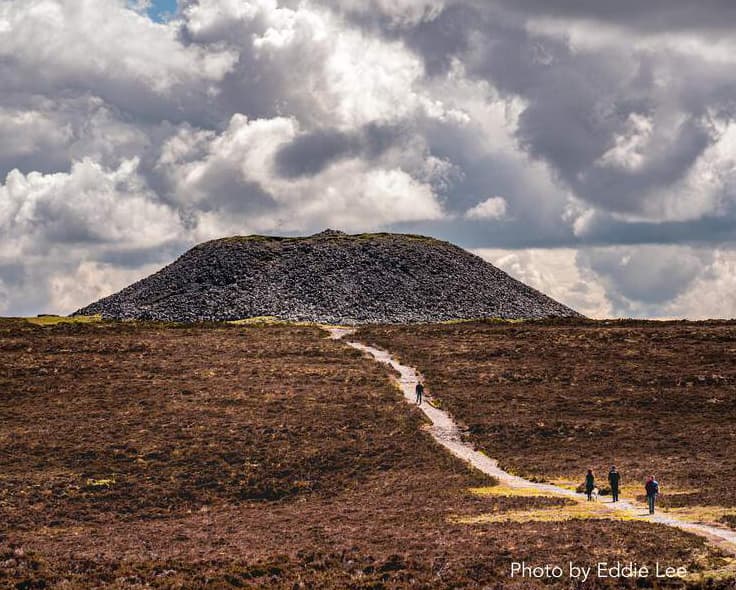
Queen Maeve's Cairn on the summit of Knocknarea, County Sligo

Queen Maeve’s Cairn, perched on the summit of Knocknarea, is one of the most impressive megalithic monuments remaining in Ireland. Knocknarea is the most prominent and beautiful mountain in County Sligo, it’s only possible rival being the majestic plateau of Benbulben.

Aside from Queen Maeve’s cairn, there are six more neolithic monuments, five on the summit, while an overgrown boulder circle is on the edge of the large lower ledge to the east. There are also the foundations of some 28 neolithic houses and 1.2 km of stone walls and banks on the south side of the summit.

The passage and chamber have remained hidden since prehistoric times. The cairn is known to be the resting place of the legendary Queen Maeve of Connaught; its good state of preservation is probably due to her fierce reputation. Maeve ruled Connaught from her palace at Rath Croghan near Tulsk in Roscommon, and she is best known for her role in the Tain Bo Culainge, where she led her province to war against Ulster to take the Brown Bull of Cooley, when Cuchullain single-handedly held off her army. That she chose to be interred in the Great Cairn of Knocknarea says something about its prestige as the most important and ancient sacred site in Connaught.

Legend tells us that Maeve was buried standing upright within the chamber, with her armour on and facing her ancient enemies in Ulster. There are also stories of chieftains being buried in Knockma, Carns Hill and Heapstown. These legendary burial practices echo the Egyptian customs of burying the kings within the pyramids – in death, they act as symbolic and spiritual guardians of the landscape they once ruled.

The Glen, Knocknarea

This magical looking glen is more characteristic of a micro-valley. The entrance is basically a hole in a hedge and there are no signs — a pity, as this place truly deserves to be seen and appreciated. Entering the deep chasm is like entering a walkway to another world! This glen is carved deep into limestone rock for almost 1 mile. There are many specimens of trees and plants growing here that look like they belong in a tropical rain forest. Vines drape from the tree canopy above right down to the valley floor, and the walls on each side rise 60 ft in height along the entire length of the glen.

The glen is near the sacred hill of Knocknarea, where the ancient queen Maeve of Ireland is buried on top. There is archaeological evidence that proves our ancestors carved rock from this glen thousands of years ago to use as Dolmen tombs across County Sligo, and theory states that they may have used this valley for ceremonial and ritual practices.

Access to the Glen can be difficult: it is a pretty overgrown spot. Trees and branches fall across the pathway, and during the wet weather often experienced in Sligo, there are often large, deep pools of mud to be crossed. Unless the weather has been dry for weeks, wellingtons or stout boots are essential.

Ceide Fields

Beneath the wild boglands of North Mayo lies Céide Fields — the world’s most extensive Stone Age monument, featuring 5,000-year-old field systems, dwellings, and megalithic tombs. The surrounding bog flora is of international importance and bordered by some of Ireland’s most striking cliffs and rock formations.

The discovery began in the 1930s when local schoolteacher Patrick Caulfield noticed piles of stones beneath the peat while cutting turf. Realising they were man-made and ancient, he sparked curiosity that decades later led his son, archaeologist Seamus Caulfield, to uncover their true significance. Excavations revealed a vast Stone Age landscape of walled fields, houses, and tombs preserved beneath the bog — a peaceful, organised farming community that thrived 5,000 years ago, skilled in stonework, woodworking, and deeply spiritual.

At the Céide Fields Centre, visitors can explore exhibitions, including a 4,300-year-old Scots Pine tree, and enjoy an audio-visual show. The pyramid-shaped glass building also features panoramic viewing platforms offering stunning sea and land views.

Knocknashee, Hill of the Fairies

Knocknashee ‘Hill of the Fairies’ is one of Ireland’s largest Bronze Age fortified hilltop forts stretching 700×320 meters across this table-top mountain plateau. Being one of Ireland’s seven most sacred hills, its name comes from the Irish words “knock” (cnoc) meaning “hill” and “shee” meaning “fairy”.

Knocknashee is a beautiful table-top mountain in south west Sligo, which rises suddenly from the drumlin plain to dominate the surrounding area, about 10km north of Tubercurry. The area around Knocknashee is thickly dotted with ringforts and mounds and there are several ruined megalithic chambers in the area, all with commanding views to the mountain. Michael Gibbons, one of Ireland’s leading field archaeologists, called it a “place apart” and “one of the great European hill-forts”.

Guided walk in the company of John Barrett, of Wild Wet Adventures (tel 086-7222750), who runs a range of outdoor activities, including guided walks, in the area — up the steep grassy slopes, over the hill-fort’s now undefended “ramparts” to the Stone Age summit tomb-cairns, with Croagh Patrick in the distant haze and Benbulben in-between.

Parkes Castle

Parkes Castle on the banks of Lough Gill, County Leitrim

Rising three storeys tall, in an idyllic setting on the banks of Lough Gill, in County Leitrim, Parke’s Castle is a plantation era castle. In 1610 Roger Parke completed his fortified manor house on the site of an earlier fifteenth-century O’Rourke (Uí Ruairc) castle. He kept the walls of the original bawn and demolished the O’Rourke tower house in the centre, using some of its stones to build the three-storey manor on the east side, eventually adorned with mullioned windows and diamond-shaped chimneys.

Excavations in 1972–73 revealed the base of the original O’Rourke tower house beneath the courtyard cobbles, now exposed to view. It was in this tower house that Francisco de Cuellar, the shipwrecked Armada officer, was entertained by Brian O’Rourke. The castle had extensive and sensitive restoration carried out at the end of the 20th century by the Office of Public Works, using techniques of the 17th century.

Opening Times: approx 21st April – 28th Sept, 10.00 – 18.00; last admission 45 minutes before closing. Average visit: 1 hour. Audio-visual presentation “Stone by Stone” (seating 40, 20 mins; English, French, German and Italian). Guided tours available on request — maximum 25, duration 40 minutes. Restaurant/tearooms open during the high season.

Ballymote Castle

Ballymote castle was built around the year 1300 by the Anglo-Norman Richard de Burgo, second Earl of Ulster, known as the ‘Red Earl’, in order to protect his newly won possessions in Sligo. The site was known as Atha Cliath an Chorainn, the ford of the hurdles of Corran. He also built a road from Boyle to Collooney called the ‘Red Earl’s Road’.

The castle was possibly the strongest in Connacht at the time. The area within the walls is 150ft square, with a formidable double towered gate in the centre of the north wall and subsidiary D-shaped towers on the East and West curtain walls. The walls are about ten feet thick and flanked with six noble towers, with passages running through their centre to meet the need of attack or defence.

The castle changed hands many times down the years — captured by the O’Connors of Sligo in 1317, taken by the Mac Diarmada in 1347, passed to the MacDonaghs by 1381 and later to O’Conor Sligo, falling into English hands in 1584 under the notorious governor of Connaught, Richard Bingham. It was from this castle that Red Hugh O’Donnell marched to the disastrous battle of Kinsale in 1601. In the Williamite wars it was held for King James II before surrendering in 1690, after which the fortifications were made harmless, the moat was filled and the castle fell into ruins. Underground passages connected Emlaghfad church with the castle and with the Franciscan Abbey.

Genealogy

If you are researching your family history and looking for your roots this is a good place to start. The County Sligo Heritage & Genealogy Centre has over twenty-five years of experience in carrying out ancestral research, enabling countless people to discover their family lineage. It is part of a national network of genealogical centres in Ireland, a member of the Irish Family History Foundation, and the officially designated Genealogy Research Centre for County Sligo.

Like many other Irish counties, Sligo has suffered greatly from emigration — according to the Census returns, a staggering 75,660 emigrated from Sligo between 1851–1901, most taking passage to New York, Boston, Quebec and Saint John New Brunswick, and later via coastal steamers to Glasgow or Liverpool. This emigration created a Sligo Diaspora worldwide who can trace their “roots” to County Sligo.

Sligo Abbey

This Dominican abbey survives from medieval days. It was built by Maurice Fitzgerald for the Dominicans in 1252 and was accidentally burnt down in 1414, when a candle left carelessly in the building set it on fire. ‘The Abbey’, as it is known locally, was further damaged during the 1641 rebellion.

Legend says that worshippers saved the abbey’s silver bell which was thrown into Lough Gill and only those free from sin can hear it peal. The site contains a great wealth of carvings including Gothic and Renaissance tomb sculpture, well preserved cloisters and the only sculptured 15th Century high altar to survive in any Irish monastic church.

Rathcroghan

Rathcroghan (Rath Cruachan – The Fort of Cruachan) is the oldest and largest unexcavated Royal Site in Europe. It is known as the Sacred Capital of Connacht, and is the location where the festival of Samhain (Halloween) is said to originate. The Rathcroghan Visitor Centre, home to interpretative rooms and a museum, is located in the medieval village of Tulsk, Co. Roscommon.

The Rathcroghan landscape boasts over 240 identified archaeological sites, contained within an area of 6.5km², ranging in date from the Neolithic Period (c. 3500 BC) through to the late Medieval period — a staggering span of over 5,500 years. It holds some 28 identified burial mounds from the Bronze and Iron Age, numerous ringforts, standing stones, linear earthworks, stone forts, a great Iron Age ritual sanctuary, and even a Gate to Hell — in truth, an archaeologist’s dream.

Tread across Rathcroghan’s ancient landscape in the footsteps of the great warrior Queen Medb, who ruled all of Connacht from her home here. Listen to the epic tale of the Táin Bó Cuailnge, featuring the Battle Goddess Mórrígan, Connacht warrior Fráoch, and the boy hero Cú Chulainn. Experience the legendary Oweynagat (Cave of the Cats), described as Ireland’s “Gate to Hell” and entrance to the Otherworld by fearful Christian scribes, and climb the majestic Rathcroghan Mound, whose secret heart remains an untouched mystery.
Statue of W.B. Yeats in Sligo town, County Sligo

The poet’s county

W.B. Yeats

W.B. Yeats drew inspiration from County Sligo all his life — a post Ice Age drama pitted with blue lakes, megalithic remains of early man and at every turn a line from the poet that captures forever the magic of the place. Visit his grave at Drumcliffe and Lissadell House, just 35 minutes north of Temple House.

“Cast a cold eye on life, on death, horseman, pass by.”

Yeats’ self-penned epitaph, Drumcliffe churchyard
Explore Yeats country

Make a Plan

Stay at Temple House

One house, given over entirely to your party — with all of this on the doorstep.